Shotsy Alternative: Why Peptide Users Choose Regimen
Last updated 2026-05-20 · iOS · Android
The Short Answer
If you're on a single branded GLP-1 like Ozempic, Wegovy, Mounjaro, or Zepbound and want a polished, consumer-friendly app with pharmacokinetic medication-level charts, integrated nutrition tracking, and the cheapest price in the category, Shotsy is purpose-built for that.
If you're running BPC-157 alongside semaglutide, managing TRT, or need a physician-ready PDF that covers your entire protocol — Shotsy doesn't support that. Regimen does, and ships AI vial-label scanning powered by Claude (Anthropic's AI) to set everything up in under a minute.
Two Different Products for Two Different Users
Shotsy and Regimen overlap on GLP-1 dose logging, but they're aimed at different users.
Shotsy is laser-focused on the GLP-1 market — Ozempic, Wegovy, Mounjaro, Zepbound, and (since version 3.0 in March 2026) the oral Rybelsus formulation. The product expresses that focus with features built around a single drug class: pharmacokinetic medication-level visualization, nutrition tracking, dose calendars, and a maintenance mode for users who've reached their goal weight.
Regimen is a broader protocol tracker. It covers GLP-1s, but also peptides (BPC-157, CJC-1295, ipamorelin, TB-500, PT-141, kisspeptin), growth hormone secretagogues, testosterone replacement, and other hormone protocols. Where Shotsy depth-optimizes for one drug class, Regimen breadth-optimizes for the full peptide / hormone landscape.
If you're only on a GLP-1, that breadth is overhead you don't need.
What Shotsy Does Well
Shotsy's strongest feature is the estimated medication level chart. Semaglutide and tirzepatide both have half-lives close to a week, which means the in-body level rises and falls in a predictable pharmacokinetic curve between doses. Shotsy renders that curve over time, so you can see when your level is peaking, when it's troughing, and how a missed or delayed dose distorts the pattern. This is a feature no other tracker in the survey ships, and it's the product's clearest justification for the Premium upgrade.
Nutrition tracking built into the dose log. Calories, protein, and water — all surfaced alongside your weekly injection record. You can associate side effects with specific meals, dose timing, or hydration levels. For users who don't want a separate nutrition app, the integration is genuinely useful.
Apple Health integration for the core metrics. Weight, calories, protein, and water sync automatically from Apple Health. The data stays on-device with iCloud sync between your own devices, which is a privacy posture worth noting.
Generous free tier. All core features — dose tracking, side effects, weight charts, nutrition logging — work without paying. The paywall sits only at the medication level visualization. For users who want a free GLP-1 tracker that covers the basics well, Shotsy is the right answer.
Android support. Shotsy ships on both iOS and Android. Regimen is iOS-only.
Maintenance mode. Once you hit a goal weight, Shotsy switches the tracker into a mode designed for the lower-frequency dosing typical of GLP-1 maintenance. Regimen doesn't have a dedicated maintenance state; you'd adjust the dose schedule manually.
What Regimen Does Differently
Regimen assumes you might be on more than one protocol — and that some of those protocols come from a provider as a printed care plan rather than a single boxed pen.
AI care-plan scanning powered by Claude. Regimen's scan-label feature uses Claude (Anthropic's AI) to read a photo of your provider's printed protocol sheet and extracts the compound, dose, frequency, and cycle structure automatically. Shotsy does not advertise anything comparable. If your protocol arrived as a PDF from a TRT clinic or a peptide prescriber, this saves real setup time.
AI vial label scanning. A second scan mode — also Claude-powered — reads individual vial labels, including the lot-code dictionaries used by common compounding pharmacies (CJCIPA → CJC+Ipamorelin, BPCTB → BPC+TB-500, SEMA → Semaglutide). Useful when you have the vial but no separate care sheet.
Human body diagram for injection rotation. Regimen renders an anatomical front/back view. You tap the exact subcutaneous or intramuscular site for each injection — abdomen, glute, deltoid, thigh, wherever your protocol calls for. Shotsy uses a list/calendar approach that suggests the next site based on history. Both rotate; the diagram is more flexible when you're injecting multiple compounds at different sites or following an unconventional rotation.
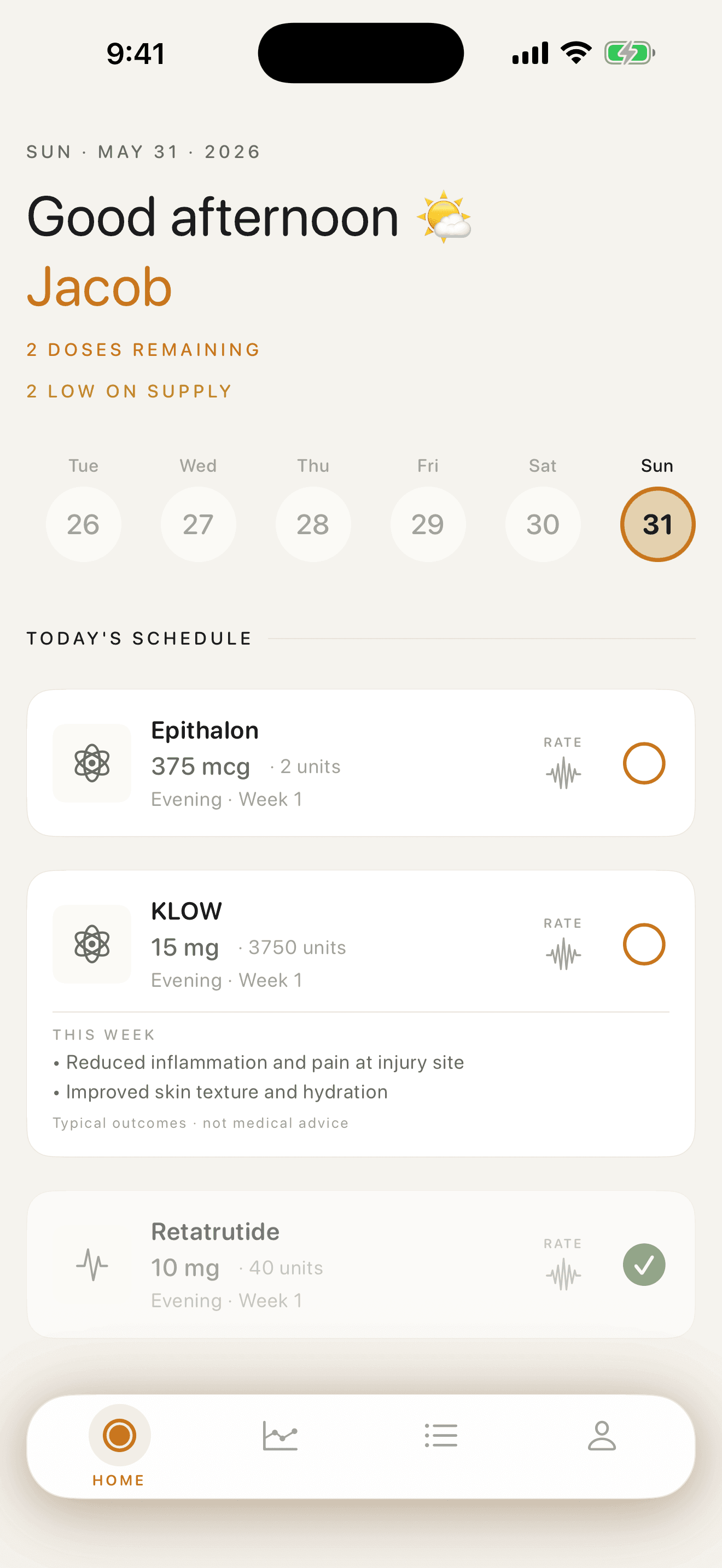
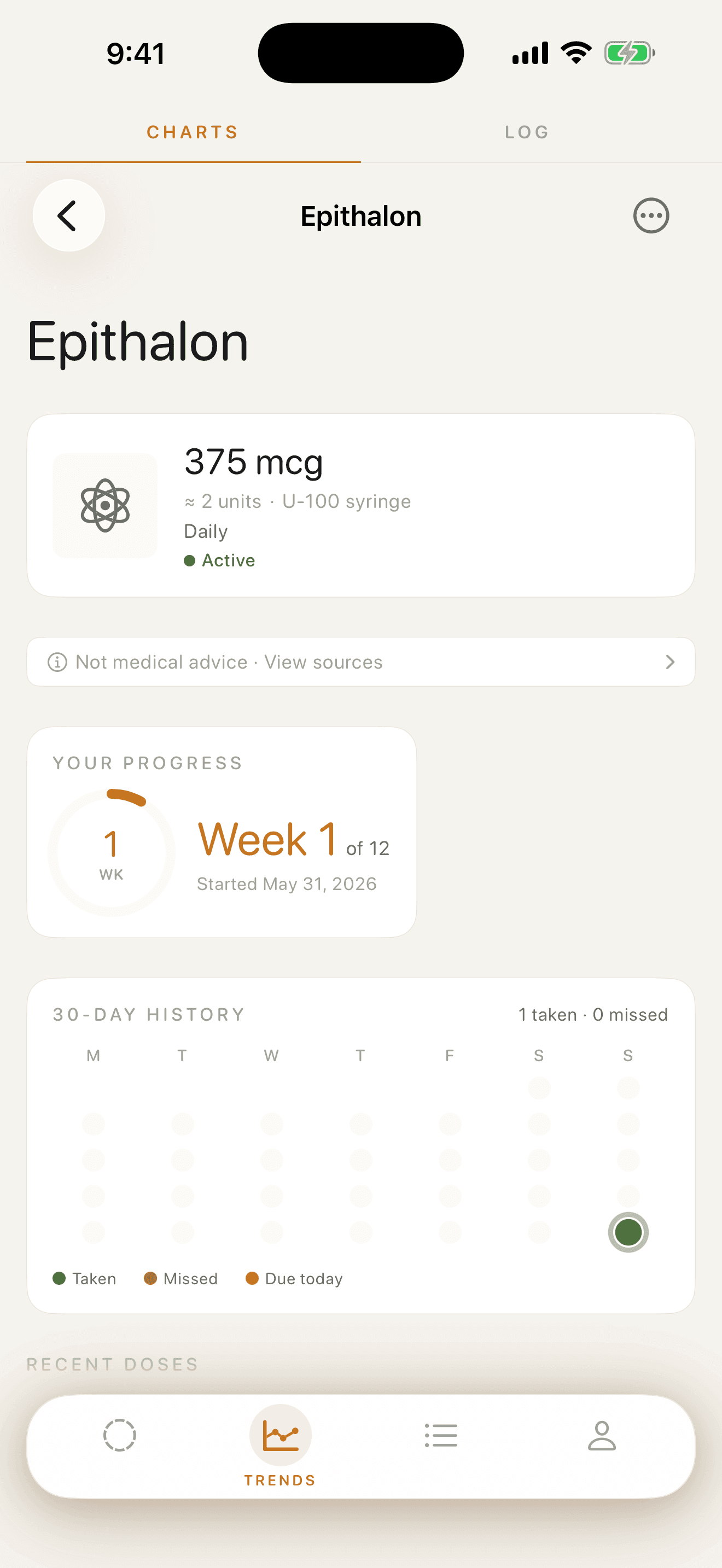
Vial supply tracking with reorder alerts. Log an open vial and the doses it holds. Regimen counts the supply down as you log, projects the run-out date by walking your dose schedule forward, and raises a Low Supply alert a configurable number of days ahead. This matters for compounded peptides where lead time on a reorder can be a week or more. Shotsy doesn't need this for boxed GLP-1 pens; the use case is peptide-specific.
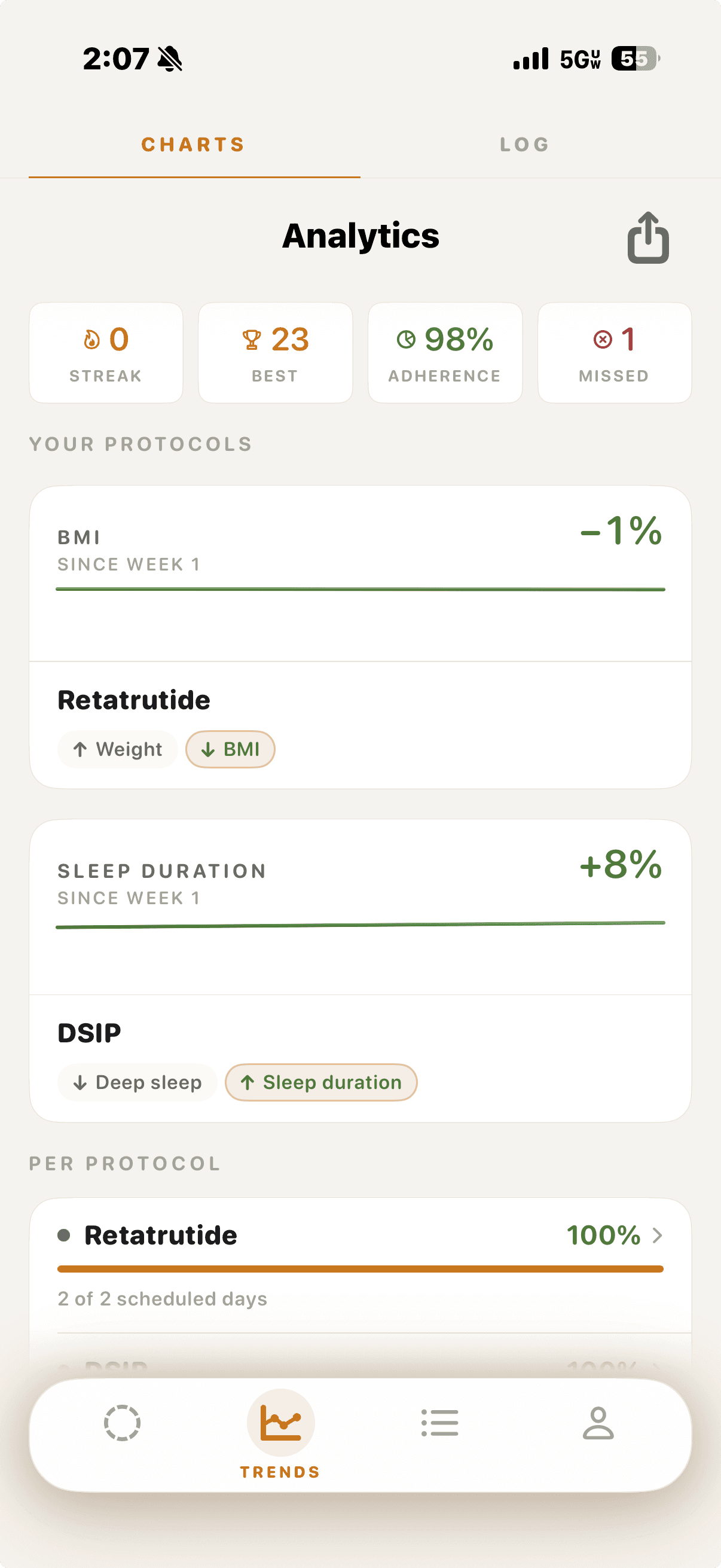
Broader Apple Health integration. Regimen reads sleep total, REM sleep, deep sleep, HRV, resting heart rate, glucose, body fat, and BMI — alongside weight. Shotsy reads weight, calories, protein, and water. If your goal is to see whether a peptide is moving sleep architecture, HRV, or fasting glucose alongside weight, the broader integration is the difference.
Tracked Outcomes + Rate Today. Regimen lets you score 16 outcome dimensions daily — mood, energy, libido, focus, sleep quality, joint pain, appetite, plus the objective Apple Health metrics. Each outcome gets a 30-day sparkline next to the dose log. The question "is this protocol actually working?" becomes a chart instead of a guess.
Reactions Journal. Side effects logged from a curated tag library (GI, mood, energy, sleep, sexual, cognitive, injection-site) with optional 1–5 severity, free-text note, and 30-day backdating. Shotsy has side-effect logging tied to specific doses and sites, which is good for GLP-1-specific GI tracking; Regimen's journal is broader, with backdating support for cycles where side effects emerge weeks after a dose.
Immutable dose ledger with soft-void undo. Every dose log in Regimen is append-only. Mistakes get voided with a timestamp rather than deleted. The history view shows both the original log and the void event. This is the design used in pharmaceutical dispensing systems and matters for users whose protocols intersect with bloodwork timing or insurance documentation.
Where Shotsy Has the Advantage
Three real advantages, and they're not small ones.
Pharmacokinetic medication level charts. Shotsy's Premium feature. Regimen doesn't do this — and given the half-life math for semaglutide and tirzepatide, the visualization is genuinely useful for GLP-1 users who want to see their in-body level over a cycle.
Built-in nutrition tracking. Calories, protein, water — Regimen doesn't ship any of this. For GLP-1 users tracking protein floor during weight loss, this is meaningful.
Cheaper price + free tier. Shotsy Premium is $7.99/month or $39.99/year (raised from $29.99/year in 2025 after their Series A). Regimen is $9.99/month or $79.99/year. Shotsy's free tier covers more than Regimen's — basically the whole product minus medication level charts.
Pricing Breakdown
| Plan | Regimen | Shotsy |
|---|---|---|
| Free trial | 7 days, no credit card, all features unlocked | Generous free tier (all core features) |
| Monthly | $9.99/month | $7.99/month |
| Annual | $79.99/year (~$6.67/month) | $39.99/year (raised from $29.99 in 2025) |
| Paywalled features | Most features after trial | Pharmacokinetic medication-level charts |
Shotsy is cheaper annually. Regimen's pricing reflects multi-compound support, Claude-powered vial OCR, injection site rotation, broader Apple Health biometric sync, and outcome tracking that Shotsy does not offer at any price. For a single GLP-1 protocol, Shotsy's lower tier makes sense; for anything broader, Regimen's scope justifies the gap.
Who Should Use Which
Choose Shotsy if: GLP-1 is your only protocol, you want pharmacokinetic medication-level visualization, you want nutrition tracking in the same app, you're on Android, or you specifically want a strong free tier.
Choose Regimen if: You're on a peptide stack, a TRT or growth-hormone protocol, or any combination of those alongside a GLP-1; you receive protocols from a provider as printed care plans and want AI to extract them; you want a broader Apple Health integration covering sleep, HRV, glucose, and body composition; you want a reactions journal with curated tags; you want an audit-grade dose ledger; or your provider wants a PDF that includes outcomes alongside doses.
The feature table above lists every difference honestly — including where Shotsy is the better tool. Neither app is universally better. They're built for different primary users.
Feature Comparison
| Feature | Shotsy | Regimen |
|---|---|---|
| GLP-1 protocol tracking (Ozempic, Wegovy, Mounjaro, Zepbound) | ✓ | ✓ |
| Peptide protocol tracking (BPC-157, CJC-1295, ipamorelin, etc.) | ✗ | ✓ |
| Hormone tracking (TRT, growth hormone, HRT) | ✗ | ✓ |
| Oral GLP-1 tracking (Rybelsus) | Added in 3.0 (March 2026) | ✓ |
| Injection site rotation | Suggests next site | Human body diagram |
| Estimated medication level charts (pharmacokinetic curves) | Premium feature | ✗ |
| Nutrition tracking (calories, protein, water) | ✓ | ✗ |
| Weight tracking via Apple Health | ✓ | ✓ |
| Sleep stages, HRV, RHR, glucose from Apple Health | ✗ | ✓ |
| Subjective outcome scoring (mood, energy, libido, focus, etc.) | ✗ | Rate Today, 16 dimensions |
| Side effect / reactions journal | Tied to dose, site, or nutrition | Curated tag library + severity + 30-day backdating |
| AI label scanning (care plan + vial) | ✗ | ✓ |
| Vial supply tracking + reorder alerts | ✗ | Run-out projection + Low Supply alert |
| Reconstitution / dose calculator | ✗ | iOS + web (free) |
| PDF report sharing (doctor visits) | Dose history export | Includes Outcomes Since Starting |
| Immutable dose ledger with undo | ✗ | ✓ |
| Maintenance mode (post-goal weight) | ✓ | ✗ |
| iCloud / cross-device sync | iCloud private sync (iOS) / Firebase (Android) | Supabase-backed account sync |
| iOS | ✓ | ✓ |
| Android | ✓ | ✗ |
| Free tier | All core features free | Limited (paywalled features after trial) |
| Monthly price (Premium) | $7.99 | $9.99 |
| Annual price (Premium) | $39.99 | $79.99 |
Based on publicly available information as of 2026-05-20.
See Regimen in action
Frequently Asked Questions
Is Shotsy or Regimen better for GLP-1 tracking?
Shotsy is purpose-built for GLP-1 users — it ships pharmacokinetic medication-level curves (semaglutide and tirzepatide both have half-lives near a week, so the curve shape matters), nutrition tracking built into the same view as dose logging, and a free tier that covers the core flow. Regimen tracks GLP-1s competently and adds AI care-plan scanning, a human body diagram for injection sites, a broader Apple Health integration (sleep, HRV, glucose), and a reactions journal — but if GLP-1 is your only protocol, Shotsy is more focused.
Does Shotsy track peptides or hormones besides GLP-1?
No. Based on Shotsy's public website as of May 2026, the app supports GLP-1 medications only — semaglutide (Ozempic, Wegovy, Rybelsus) and tirzepatide (Mounjaro, Zepbound), with multi-medication scheduling added in version 3.0. Peptides like BPC-157, CJC-1295/ipamorelin, TB-500, PT-141, or testosterone replacement are out of scope. If your protocol includes any of those, Regimen covers them in the same app as your GLP-1.
How does pricing compare?
Shotsy is the cheaper option. Premium is $7.99/month or $39.99/year (raised from $29.99 in 2025 after their Series A). All core features — dose logging, side effects, weight, nutrition — are free. The paywall sits at the estimated medication level visualization. Regimen is $9.99/month or $79.99/year with a 7-day free trial covering the full feature set.
Does either app have estimated medication level charts?
Only Shotsy. Their Premium tier visualizes the pharmacokinetic curve of your GLP-1 over time based on dose, frequency, and the published half-life. It's a real product differentiator. Regimen does not currently show pharmacokinetic curves — the focus is on dose history, outcomes correlation, and protocol management rather than per-molecule level modeling.
Which app is better for injection site rotation?
Regimen renders a full anatomical human body diagram — you tap the exact site on a front/back view of the body. Shotsy uses a list/calendar approach that suggests the next site based on history. Both rotate sites; the interaction model differs. The diagram-based approach is more useful when you're injecting at multiple non-standard sites or stacking multiple compounds at different anatomical locations.
Does Shotsy do nutrition tracking?
Yes — Shotsy tracks calories, protein, and water intake alongside doses, and pulls some of those values from Apple Health. This is a real Shotsy advantage if you want nutrition and GLP-1 dosing in the same app. Regimen does not currently offer nutrition logging; users typically pair Regimen with MyFitnessPal, Cronometer, or LoseIt for that.
Can I share my dose history with my doctor from either app?
Both apps support a PDF export. Shotsy's PDF compiles dose history. Regimen's PDF compiles dose history alongside the Outcomes Since Starting block (subjective ratings + Apple Health biometrics) and the Reactions Journal entries, so a prescriber sees the full picture in one document. If your provider wants context beyond dose dates, the Regimen PDF carries more.
Which app supports Android?
Shotsy supports both iOS and Android. Regimen is currently iOS-only. There is no Android version of Regimen planned for the near term.