Regimen vs Peptiq: AI Scanning vs Calculator Stack
Last updated 2026-05-16 · iOS · Android
The Short Answer
If your protocol is peptide-only and you want a deep reference database with a calculator stack — reconstitution math, unit conversion, vial duration and cost calculations — Peptiq covers that ground well and ships on both iOS and Android.
If you're running peptides alongside a GLP-1, TRT, or a hormone protocol, or you want AI vial-label scanning powered by Claude (Anthropic's AI), an audit-grade immutable dose ledger, a human body diagram for injection rotation, or a doctor-ready PDF that combines dose history with outcomes data, Regimen is built for that use case.
Two Different Tools for Two Different Jobs
Peptiq and Regimen both serve peptide users, but they have meaningfully different designs. Peptiq is built around a calculator and reference stack: reconstitution calculator, unit converter, vial duration and cost calculator, and a 35-peptide database with full profiles. Regimen is built around a dose audit trail: AI care-plan scanning powered by Claude (Anthropic's AI), an immutable ledger, and doctor-ready PDF output.
That difference is worth understanding before you choose.
What Peptiq Does Well
Peptiq advertises itself as "Your Complete Peptide Companion" and leans into education alongside tracking. Their peptide database covers 35+ compounds with dosing guidelines, mechanisms of action, and reference data. The reconstitution calculator handles BAC water math — how many units to draw for a target dose based on vial concentration. They also offer a unit converter (mcg, mg, IU), vial duration and cost calculator, and wellness tracking for mood, energy, sleep, and weight.
They support both iOS and Android, which matters if you're on a different platform than iPhone. Their premium tier includes a 7-day free trial (exact pricing not listed publicly on peptiq.io as of April 2026 — check their site for current numbers).
Peptiq also offers protocol templates and a stack optimizer, which can help first-time users who don't have a provider-issued care plan and need guidance building a protocol from scratch.
What Regimen Does Differently
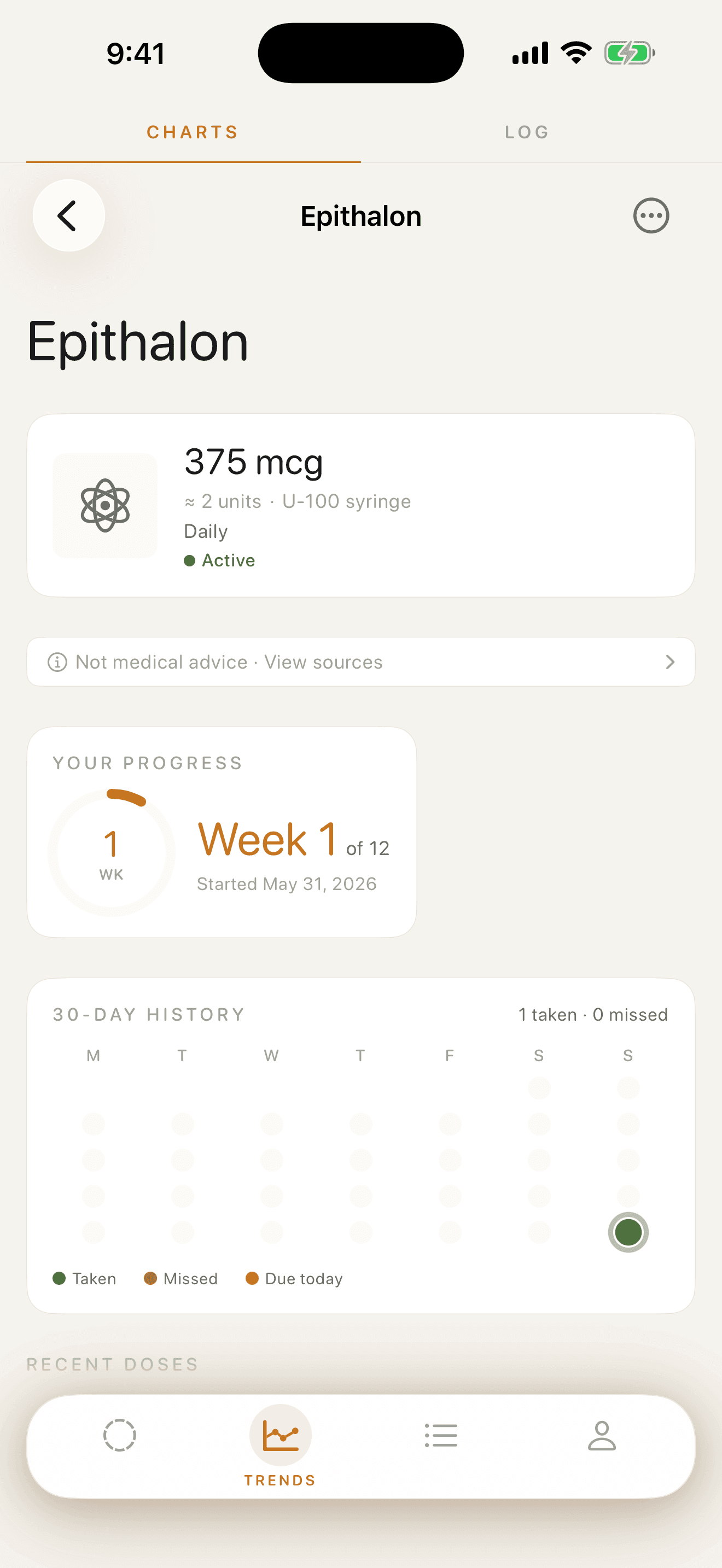
Regimen assumes you already have a protocol — from a TRT clinic, a peptide prescriber, or a compounding pharmacy. The app is designed to execute that protocol faithfully and document it.
AI care-plan scanning powered by Claude. Regimen's scan-label feature uses Claude (Anthropic's AI) to read a photo of a provider's printed protocol sheet. It extracts the compound name, dose, frequency, and cycle structure automatically. No competitor in this survey advertises anything comparable. If you receive protocols as PDFs or printed sheets, this saves meaningful setup time and reduces transcription errors.
Vial label scanning. A second scan mode reads individual vial labels — handles the lot code dictionaries for common compounding house codes like CJCIPA (CJC+Ipamorelin) and BPCTB (BPC+TB-500) — and creates a protocol from the vial alone. Useful when you have the vial but no separate care sheet.
Human body diagram for injection rotation. Regimen's injection site picker shows an anatomical front/back view of the body. You tap the exact muscle or subcutaneous site for each dose. The app tracks which sites were used and when, and surfaces them for each dose log. Peptiq advertises an injection site tracker, but based on their public listing, it appears to be table-based rather than a body diagram. The visual distinction matters for users who rotate through multiple sites on a complex multi-compound stack.
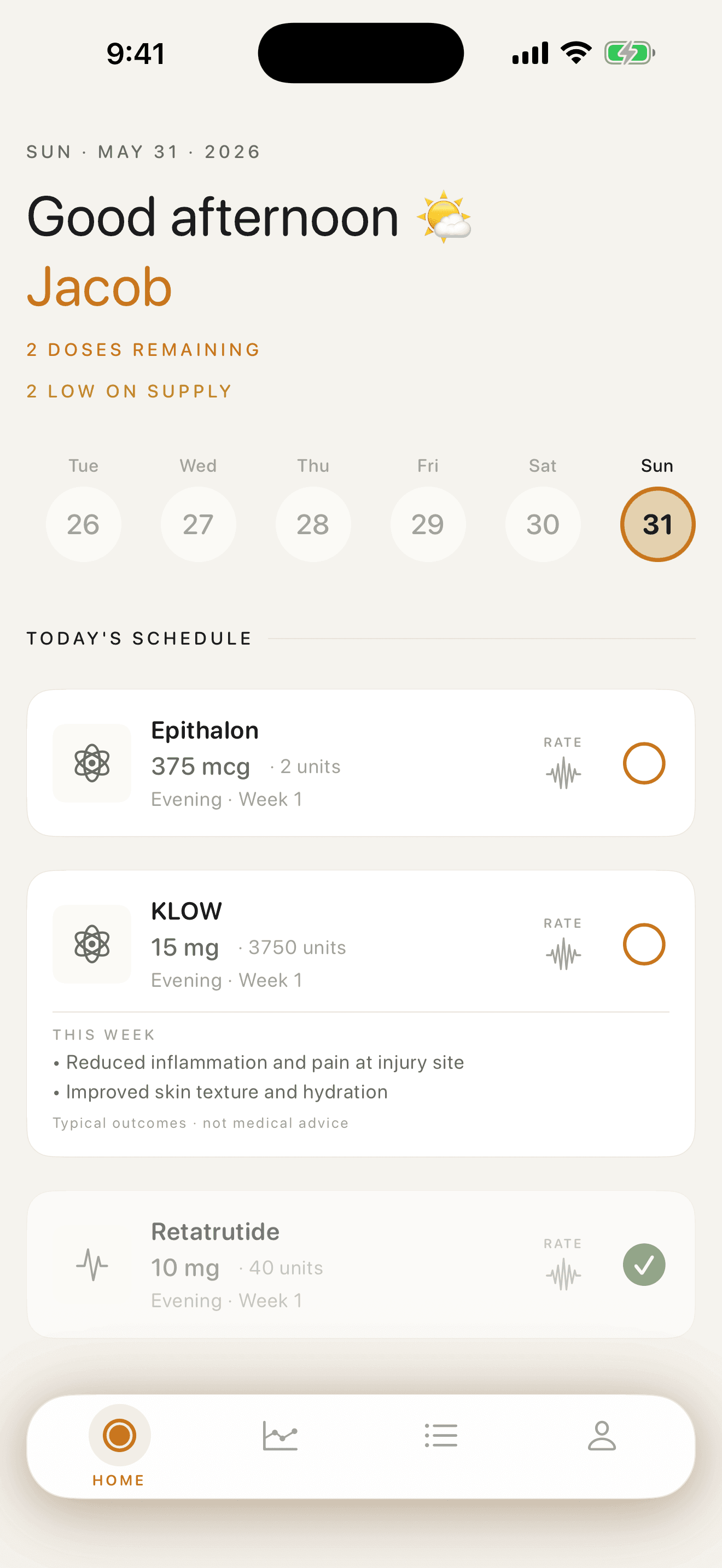
Vial supply tracking with reorder alerts. Log an open vial and the number of doses it holds. Regimen counts the supply down as you log doses, projects the run-out date by walking your dose schedule forward, and raises a Low Supply alert a configurable number of days ahead so you can reorder before you run dry. Peptiq's vial duration calculator estimates how long a vial lasts; Regimen tracks the live supply and pushes the alert.
Immutable dose ledger with soft-void undo. Every dose log in Regimen is append-only. If you log in error, you don't delete the record — you void it with a timestamp. The history view shows both the original log and the void event. This is the same design used in pharmaceutical dispensing systems. Peptiq does not mention an audit trail or soft-void capability on their public site.
PDF report sharing. Regimen generates your dose history as a formatted PDF designed for provider review. You can filter by date range and compound, then share the file directly from the app. This is the "doctor visit" flow. Peptiq does not advertise a PDF sharing feature.
Where Peptiq Has the Advantage
Peptiq still has the deeper calculator stack. Regimen ships a reconstitution calculator (the Built-In Dose Planner is on iOS inside the protocol setup screen and on the web at /calculators/dose-planner — same math, byte-for-byte verified), but unit conversion (mcg/mg/IU as a standalone tool) and a dedicated vial cost calculator remain on the backlog. Vial duration is no longer a gap — Regimen now tracks an open vial's remaining doses and projects its run-out date directly, with a reorder alert. If standalone conversion and cost estimation matter, Peptiq covers those today.
Peptiq also has deeper reference content. Their 35+ peptide database with full profiles — mechanisms, dosing guidelines, stacking recommendations — is more extensive than Regimen's compound catalog, though Regimen's catalog now ships subtitles, mechanisms, components, benefits, side effects, contraindications, sourced citations, and an outcome timeline per compound, narrowing that gap considerably.
Android support. Peptiq ships on Android. Regimen is iOS-only.
Where Regimen Caught Up: Outcomes + Reactions
The 1.17 release added two things that used to be Peptiq-only territory.
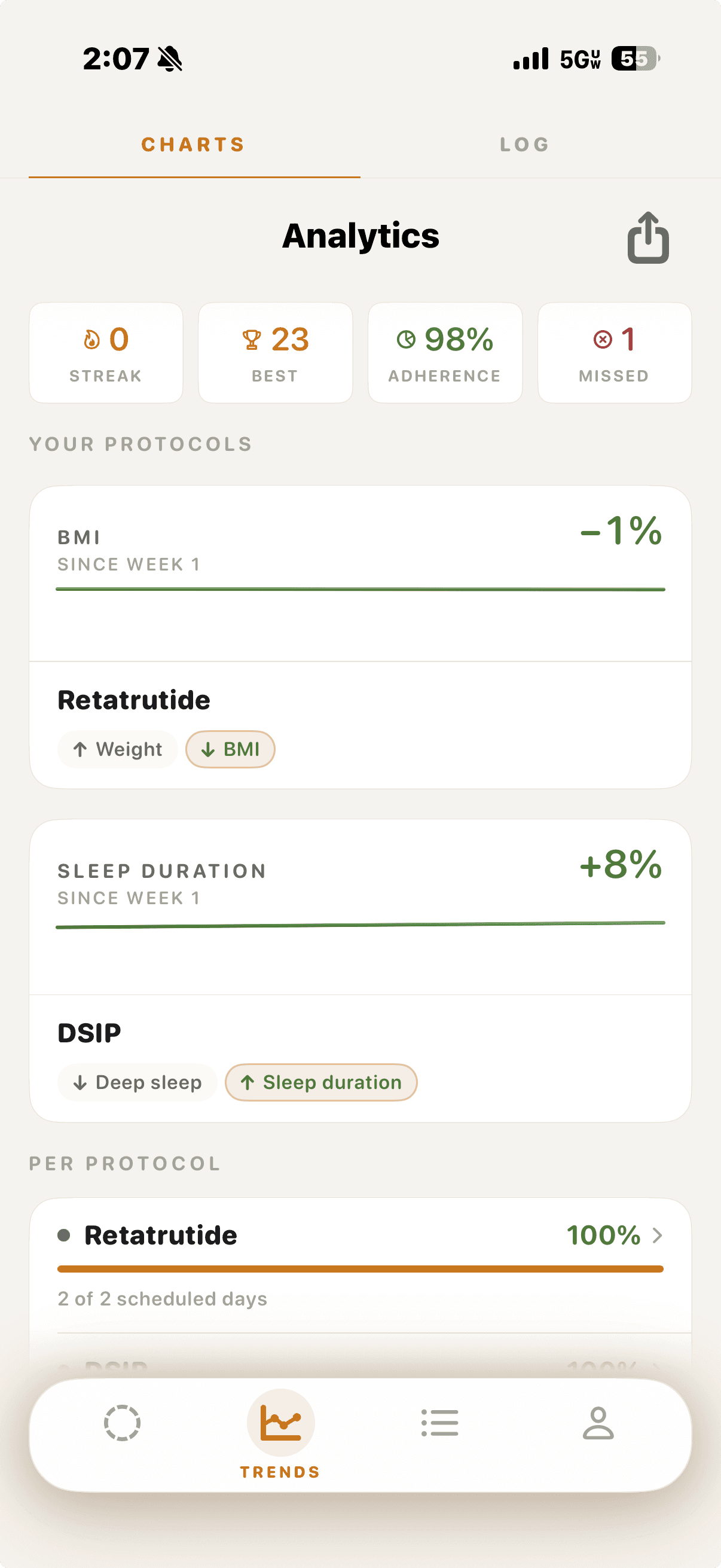
Tracked Outcomes & Rate Today. Score how you feel each day across the dimensions that compound is supposed to move — mood, energy, libido, sleep quality, focus, joint pain, appetite. Apple Health fills in the objective metrics: weight, body fat, sleep stages (REM, deep, light, awake), HRV, resting heart rate, glucose, BMI. Each outcome gets a 30-day sparkline next to your dose history, so the question "is this protocol actually working?" gets a chart instead of a guess.
Reactions Journal. Log side effects tagged from a curated library across GI, mood, energy, sleep, sexual, cognitive, and injection-site categories — plus user-defined custom tags. Optional 1–5 severity, free-text note, and 30-day backdating. Reactions appear in History with their own filter chip, and every protocol has a Reactions block on its detail screen with a 30-day sparkline.
Both ship in the iOS app today and feed into the PDF report's Outcomes Since Starting section so your provider sees them at the same time as the dose log.
Pricing Breakdown
| Plan | Regimen | Peptiq |
|---|---|---|
| Free trial | 7 days, no credit card, all features unlocked | 7-day free trial (Premium) |
| Monthly | $9.99/month | Not published |
| Annual | $79.99/year (~$6.67/month) | Not published |
Peptiq does not publish Premium pricing on their public site as of this writing — check peptiq.io for current numbers. Regimen's pricing reflects multi-compound support across peptides, GLP-1s, and hormones; Claude-powered vial OCR; injection site rotation; Apple Health biometric sync covering sleep, HRV, and glucose; outcomes tracking; and a physician-formatted PDF report.
Who Should Use Which
Choose Peptiq if: You want a unit converter and vial cost/duration tools in the same app as your tracker, you want their deep reference content for early-stage compound research, or you're on Android.
Choose Regimen if: You receive protocols from a provider as a printed care plan or PDF, you want AI to extract your protocol from a photo so you don't have to type it, you need an audit-grade ledger with soft-void that you can defend to a medical professional, you want subjective ratings paired with Apple Health biometrics on every protocol, you want a reactions journal for side effects, or you have a doctor who wants a formatted PDF of your dose history with outcomes attached.
The comparison table above shows every feature honestly — including where Regimen shows a gap. Neither app is universally better. They're built for different primary use cases.
Feature Comparison
| Feature | Peptiq | Regimen |
|---|---|---|
| Peptide protocol tracking | ✓ | ✓ |
| Cycling tracker (on/off weeks) | ✓ | ✓ |
| Injection site rotation | Tracker (table-based) | Human body diagram |
| Reconstitution calculator | ✓ | iOS + web |
| Unit converter (mcg/mg/IU) | ✓ | ✗ |
| Vial cost/duration calculator | ✓ | ✗ |
| Vial supply tracking + reorder alerts | ✗ | Run-out projection + Low Supply alert |
| Peptide reference database | 35+ with full profiles | Compound catalog |
| Subjective + objective outcome tracking | Wellness/mood only | Rate Today + Apple Health |
| Apple Health integration | ✗ | Sleep stages, weight, HRV, RHR, glucose |
| Reactions / side-effect journal | ✗ | Curated tag library + severity |
| AI label scanning (care plan + vial) | ✗ | ✓ |
| PDF report sharing (doctor visits) | ✗ | Includes Outcomes Since Starting |
| Immutable dose ledger with undo | ✗ | ✓ |
| iOS | ✓ | ✓ |
| Android | ✓ | ✗ |
Based on publicly available information as of 2026-05-16.
See Regimen in action
Frequently Asked Questions
Does Peptiq have AI label scanning?
Based on Peptiq's public website (peptiq.io), no AI label scanning or care-plan ingestion feature is mentioned. Regimen's scan-label feature uses AI to read a photo of your provider's protocol sheet or a vial label and extract the compound, dose, and schedule automatically.
Does Regimen have a reconstitution calculator?
Yes — the Built-In Dose Planner is available on iOS inside the protocol setup screen and on the web at /calculators/dose-planner. Same math on both surfaces, byte-for-byte verified. Peptiq still has the edge on standalone unit conversion and a dedicated vial cost calculator. Vial duration is no longer a gap: Regimen tracks an open vial directly and projects its run-out date from your dose schedule.
Can either app tell me when to reorder a vial?
Regimen tracks vial supply directly. Log an open vial and the doses it holds, and as you log doses Regimen counts the supply down and projects the run-out date from your schedule. A Low Supply alert fires a configurable number of days ahead — 7 by default — by push or email, so you can reorder in time. Peptiq offers a vial duration/cost calculator that estimates how long a vial lasts, but based on their public site it does not raise an active reorder alert as your supply depletes.
Which app supports Android?
Peptiq supports both iOS and Android. Regimen is currently iOS-only. There is no Android version of Regimen planned for the near term.
Which is better for serious protocol tracking?
It depends on what "serious" means to you. If you want calculator tools and a deep peptide reference database, Peptiq has more of that. If you want an audit-grade dose ledger, AI care-plan scanning, a human body diagram for injection rotation, an outcomes tracker that pairs your subjective ratings with Apple Health biometrics, a reactions journal, and a PDF you can hand to your doctor, Regimen is designed for exactly that use case.
Does Regimen track wellness, mood, or side effects?
Yes. Regimen 1.17 added Tracked Outcomes (Rate Today scoring across mood, energy, libido, sleep, focus, joint pain, appetite — plus objective Apple Health metrics like weight, sleep stages, HRV, RHR, glucose, BMI) and a Reactions Journal (side-effect logging with curated tags, severity, notes, and 30-day backdating). Both feed into the PDF doctor report.
How does pricing compare?
Both apps offer a free tier and a premium paid tier. Peptiq's exact premium price is not published on their home page as of this writing — check peptiq.io for current pricing. Regimen is $9.99/month or $79.99/year with a 7-day free trial.
Which app has better injection site tracking?
Regimen uses a full human body diagram where you tap the exact site on an anatomical front/back view. Peptiq advertises an "injection site rotation tracker" which, based on their public listing, appears to be table-based tracking rather than a body diagram. Both apps rotate sites, but the interaction model differs.