PeptideKit Alternative: Why Peptide Users Choose Regimen
Last updated 2026-05-16 · iOS
Regimen vs PeptideKit: Two Peptide-Focused iOS Apps
Regimen and PeptideKit are both built for peptide users on iOS — but they solve different parts of the problem. PeptideKit is a therapy companion with progress tracking and an AI chat assistant. Regimen is a protocol tracker with AI label scanning and an immutable dose ledger.
What PeptideKit does well
PeptideKit positions itself as a "complete peptide therapy companion," and the feature set reflects that ambition. The app includes multi-metric progress tracking across seven categories: weight loss analytics, muscle growth, anti-aging metrics, hormone balance, injury recovery, energy and performance, and cognitive function. Each metric has its own tracking view with 7-day, 30-day, 90-day, and yearly analytics.
The comprehensive journal is a notable feature — you can associate journal entries with specific doses and log side effects alongside your protocol. For users who want to correlate how they feel with what they are taking, this is genuinely useful.
PeptideKit also includes a built-in AI chat assistant for peptide therapy questions. This is a different application of AI than what Regimen offers, and it serves a different need: education and guidance versus protocol extraction.
The scheduling system supports daily, weekly, bi-weekly, monthly, every X days, and custom intervals with an interactive color-coded calendar. Local notifications keep you on schedule. All data stays on-device — no cloud sync, no accounts, no data collection.
Pricing is flexible: a free base tier with Plus upgrades available weekly ($3.99), monthly ($9.99), yearly ($39.99–$49.99), or as a one-time lifetime purchase ($69.99). The lifetime option is unique in this market.
Where Regimen differs
Regimen's core assumption is different: you are running a structured protocol with specific cycling rules, and you need an auditable record of every dose.
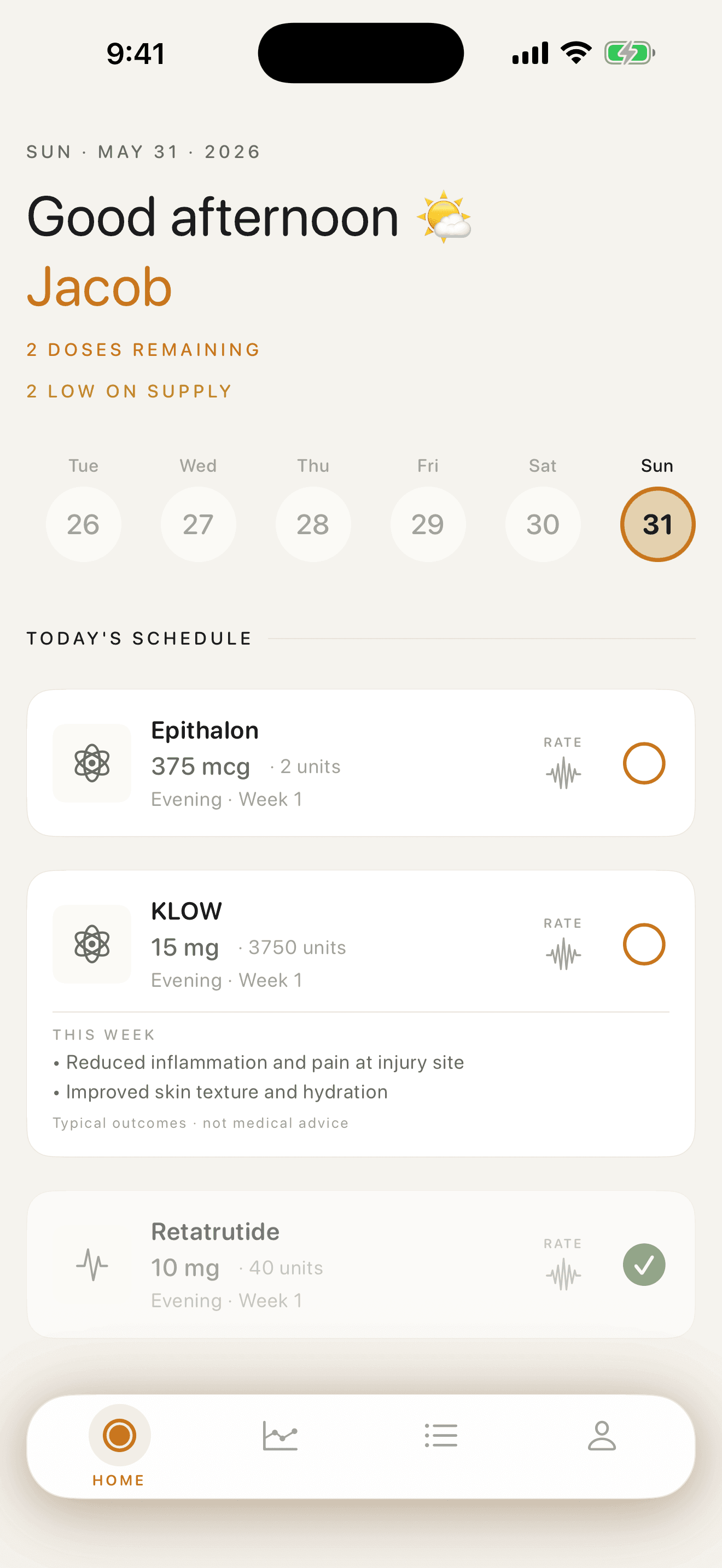
AI label scanning is Regimen's signature feature. Photograph your provider's care plan or a vial label, and AI extracts the compound name, dose, frequency, and cycling schedule. This replaces manual data entry entirely for users whose providers give them written protocols.
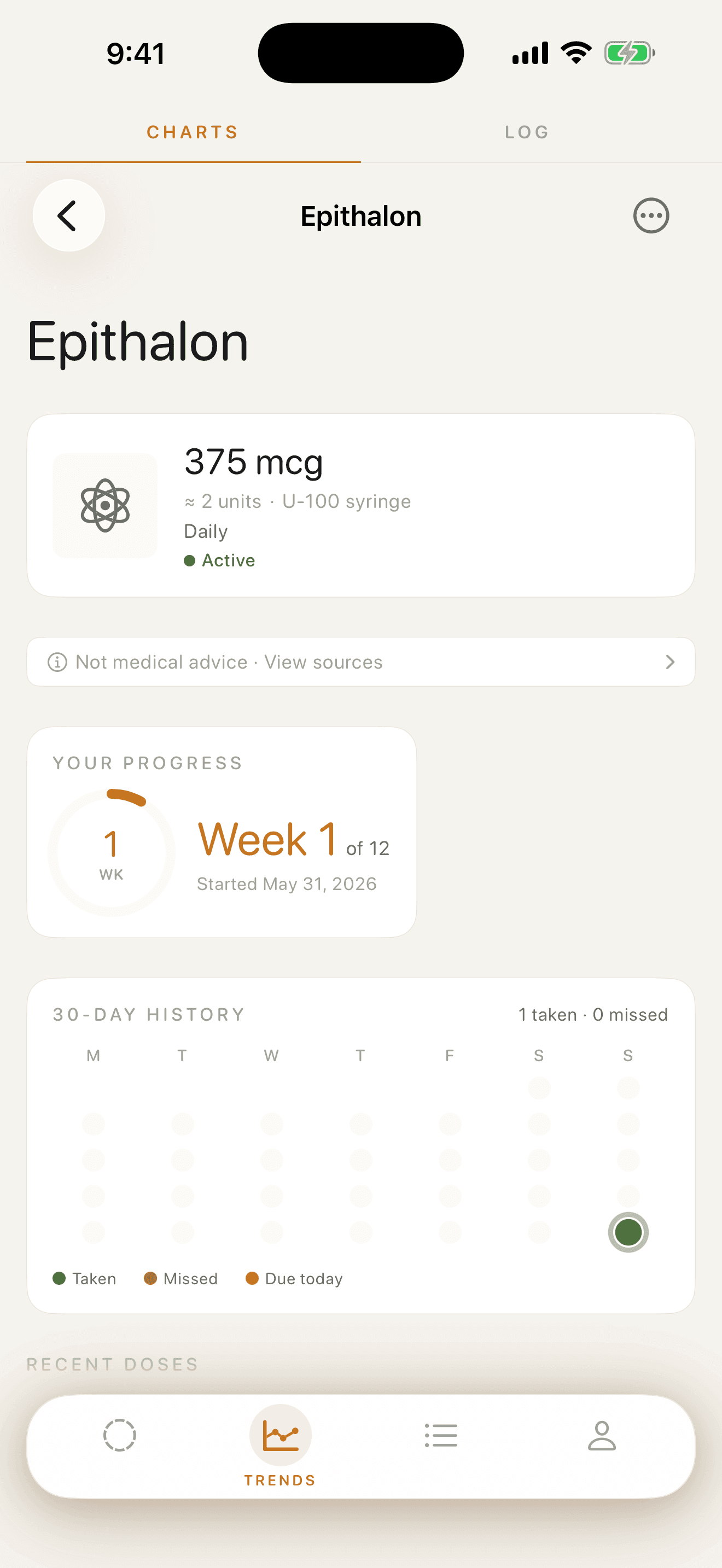
The cycling tracker manages on and off weeks automatically — your protocol defines the cycle length and the app handles the rest, including pausing reminders during off weeks. PeptideKit's flexible scheduling handles varied intervals but does not appear to have dedicated cycling logic.
Injection site rotation with a human body diagram gives you a visual record of where you have injected and when. For users running multi-compound stacks who inject at different sites, this prevents doubling up and helps maintain tissue health.
The dose ledger is immutable. Every log is permanent. Corrections are handled by voiding the original entry and creating a new one. This creates a complete audit trail that you can share as a formatted PDF with your provider.
The honest comparison
PeptideKit has features Regimen does not: an AI chat assistant, a color-coded calendar, and a lifetime purchase option. These matter for users who want a "ask my app questions" experience or a one-time payment.
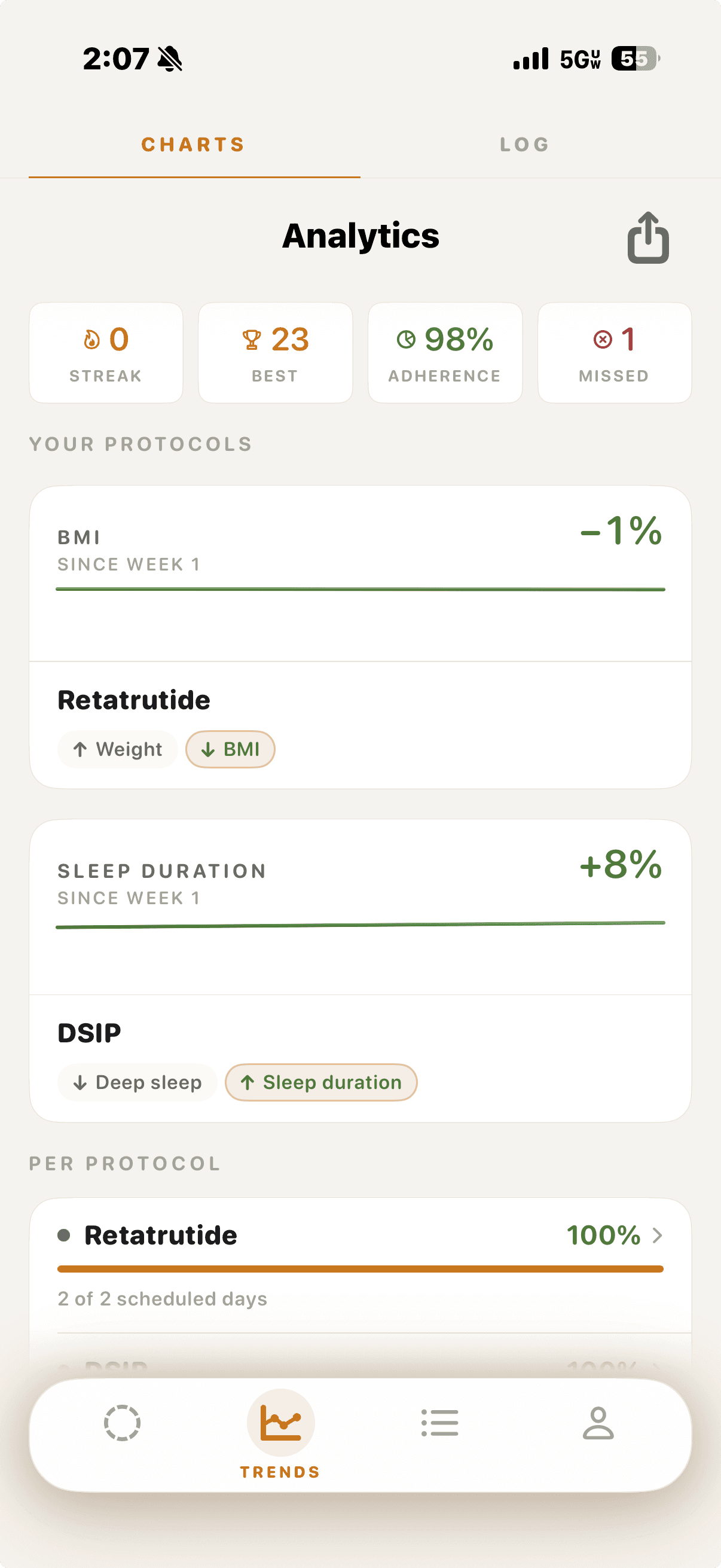
Regimen has features PeptideKit does not: AI label scanning from care plans and vials, dedicated cycling on/off schedules, injection site rotation with a body diagram, an immutable dose ledger, an Apple Health read-only sync that pairs sleep stages, weight, HRV, and glucose with your dose log, and a Tracked Outcomes system that anchors subjective ratings + Apple Health biometrics to each protocol with a 30-day sparkline, and vial inventory tracking that projects when an open vial runs out and alerts you when to reorder. These matter for users who need precision protocol management, want to know whether the protocol is actually working, and need doctor-ready documentation that includes outcomes alongside doses.
Side-effect logging is now table stakes in both apps. Regimen 1.17.1 added the Reactions Journal — a curated tag library across GI, mood, energy, sleep, sexual, cognitive, and injection-site categories, with severity, free-text notes, and 30-day backdating. PeptideKit's journal organizes the same kind of data slightly differently; the underlying capability is comparable.
Both are iOS-only. Both emphasize privacy. Both generate PDFs you can share with your doctor.
Which should you choose?
If you want an AI chat assistant for peptide questions, a color-coded calendar, or a one-time lifetime purchase — PeptideKit. If you want a focused protocol tracker that reads your care plan with AI, manages your cycles, anchors subjective ratings + Apple Health biometrics to each protocol so you can answer "is this working?", logs side effects with curated tags, and keeps a tamper-proof dose record you can hand to a doctor — Regimen. Different tools for different workflows.
Feature Comparison
| Feature | PeptideKit | Regimen |
|---|---|---|
| Peptide protocol tracking | ✓ | ✓ |
| Cycling tracker (on/off weeks) | ✗ | ✓ |
| Injection site rotation | ✗ | Human body diagram |
| AI label scanning (care plan + vial) | ✗ | ✓ |
| Built-in dose planner / reconstitution calculator | ✗ | iOS + web |
| AI chat assistant | Plus only | ✗ |
| Subjective + objective outcome tracking | Multi-metric progress | Rate Today + Apple Health |
| Apple Health integration | ✗ | Sleep stages, weight, HRV, RHR, glucose |
| Side-effect / reactions journal | ✓ | Curated tag library + severity |
| PDF report sharing | Plus only | Includes Outcomes Since Starting |
| Immutable dose ledger with undo | ✗ | ✓ |
| Smart reminders | ✓ | ✓ |
| Color-coded calendar | ✓ | ✗ |
| Vial supply tracking + reorder alerts | ✗ | Run-out projection + Low Supply alert |
| iOS | ✓ | ✓ |
| Android | ✗ | ✗ |
Based on publicly available information as of 2026-05-16.
See Regimen in action
Frequently Asked Questions
Does PeptideKit have cycling schedule support?
Based on publicly available information, PeptideKit supports flexible scheduling (daily, weekly, bi-weekly, monthly, every X days, custom) but does not advertise dedicated cycling on/off week logic. Regimen has a built-in cycling tracker that manages on/off week schedules and pauses reminders during off weeks automatically.
Does Regimen have an AI chat assistant like PeptideKit?
No. PeptideKit includes a built-in AI chat assistant for peptide therapy questions. Regimen uses AI differently — for scanning care plan and vial label photos to extract protocol details automatically. Regimen does not have a general-purpose AI chat feature.
How does progress tracking compare between the two apps?
PeptideKit offers multi-metric progress tracking across 7 categories: weight loss, muscle growth, anti-aging, hormone balance, injury recovery, energy/performance, and cognitive function with journal entries and side effect logging. Regimen ships Tracked Outcomes (subjective ratings across mood, energy, libido, sleep, focus, joint pain, appetite plus objective Apple Health metrics like weight, sleep stages, HRV, RHR, glucose, BMI on every protocol), a Reactions Journal with curated side-effect tags and severity, and an Apple Health read-only sync that surfaces sleep stages, weight, body composition, HRV, resting heart rate, and activity. Both apps track wellness; PeptideKit organizes it by goal category, Regimen anchors it per-protocol with sparklines.
Does PeptideKit have injection site rotation?
Based on publicly available information, PeptideKit does not advertise injection site rotation or a body diagram. Regimen includes a human body diagram where you tap to record each injection site, with visual history showing your rotation pattern.
How does pricing compare?
PeptideKit offers a free tier with Plus upgrades starting at $3.99/week, $9.99/month, $39.99–$49.99/year, or a $69.99 lifetime option. Regimen is $9.99/month or $79.99/year with a 7-day free trial. PeptideKit has a cheaper annual tier and a lifetime purchase option that Regimen does not offer.
Which app stores data more privately?
Both apps emphasize privacy. PeptideKit stores data locally on-device with no cloud sync of sensitive data. Regimen stores data on secure cloud servers with encryption at rest and row-level security — this enables multi-device sync but means data leaves the device. If local-only storage is a priority, PeptideKit has the edge.
Does either app track vial supply and reorder timing?
Regimen does. You log an open vial and the number of doses it holds; Regimen counts the supply down as you log doses, projects the run-out date from your dose schedule, and raises a Low Supply alert a configurable number of days ahead — 7 by default — so you can reorder in time. PeptideKit focuses on progress tracking and scheduling; vial supply tracking with reorder alerts is not advertised on their public listing.